
Hey, everyone. My name’s Nate, and I’m on a mission to help find a cure for Charcot-Marie-Tooth disease, subtype 1A (CMT1A)—a genetic disease that affects my son. You can read more about my story here, but in short, I left behind a career in the Army to pursue research, which eventually led me to what you’re reading right now.
As of late September of this year, I’ve begun documenting this mission as I speak with researchers, raise funds, and do everything I can to scour the Earth for a cure. I have no idea where this will take me, who I’ll speak to, or what puzzles I’ll have to piece together along the way, but one thing is certain: this disease will end in my lifetime, or I’ll die working on it.
Most of this journey will be documented on my YouTube channel, with conversations also available in podcast format on Spotify. At the same time, I’ll be fundraising to help provide promising researchers with grant funding. So, if you want to contribute, which would be super cool, you can do that here.
My nonprofit is called Versus CMT, and it is an official 501(c)(3). Donated funds will go toward the researchers and projects my team and I believe are most crucial to solving each piece of the CMT1A puzzle—from the delivery vehicle (viruses, lipid nanoparticles, etc.) to the “payload” (what actually goes inside that vehicle to alter or overcome the mutation), and everything vital that happens in between.
As I go, I’ll continually update the Research page to break down what I’m learning in a way that a general audience can understand. I’ll also share where the money is going, what research it’s supporting, and why I believe that work matters.
Oh, and one last thing before I let you explore the website for yourself: as another way to spread the word about this mission, I’ll also be sitting down for podcast conversations with influencers and others with large followings. These conversations may have next to nothing to do with CMT or science—and that’s kind of the point. I think they’ll be a fun way to mix things up, talk with interesting people, explore some other topics I find fascinating, and hopefully introduce this mission to people who otherwise may never have heard of CMT.
Stay tuned, and thank you for anything you contribute—even if it’s something as simple as sharing my mission.
WHAT IS CHARCOT-MARIE-TOOTH?
Charcot-Marie-Tooth disease (CMT) is a group of inherited disorders that cause damage to the peripheral nerves—the nerves that carry signals between the brain and spinal cord and the rest of the body. It is one of the most common inherited neurological disorders, affecting approximately 1 in 2,500 people worldwide.
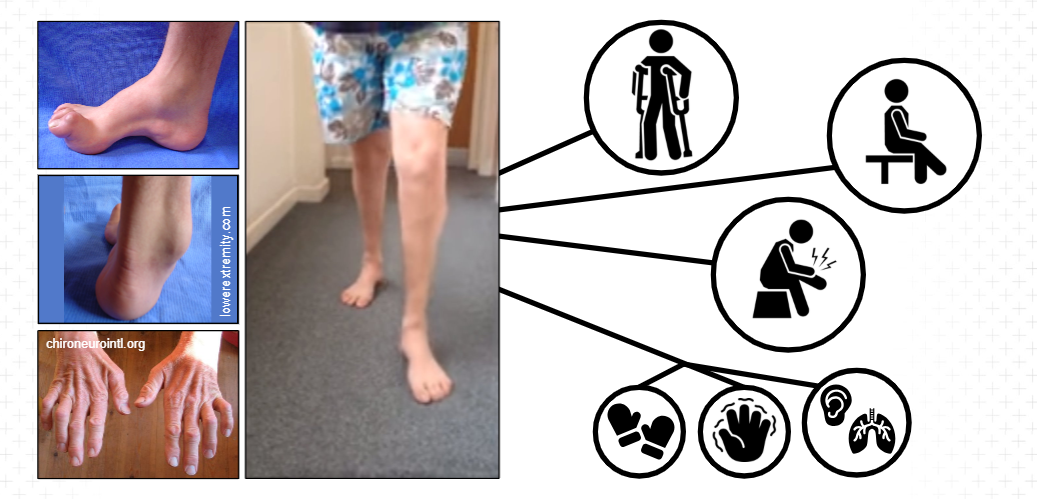
People living with CMT can experience muscle weakness and wasting, decreased sensation, frequent tripping, difficulty using their hands, and foot deformities such as high arches and hammertoes. Severity can vary significantly from person to person.
The subtype I’m focused on, CMT1A, is caused by a duplication of a section of DNA containing the peripheral myelin protein 22 (PMP22) gene. Instead of the usual two copies—one from each parent—people with CMT1A typically have three. This causes too much PMP22 protein to be produced, disrupting the Schwann cells that build and maintain myelin around our peripheral nerves.
Think of a peripheral nerve like an electrical wire and myelin as the insulation wrapped around it. In CMT1A, that insulation doesn’t function properly, causing nerve signals to travel more slowly and less reliably. Because the longest nerves have the farthest distance to travel, the effects are often most noticeable in the feet, lower legs, and hands.